

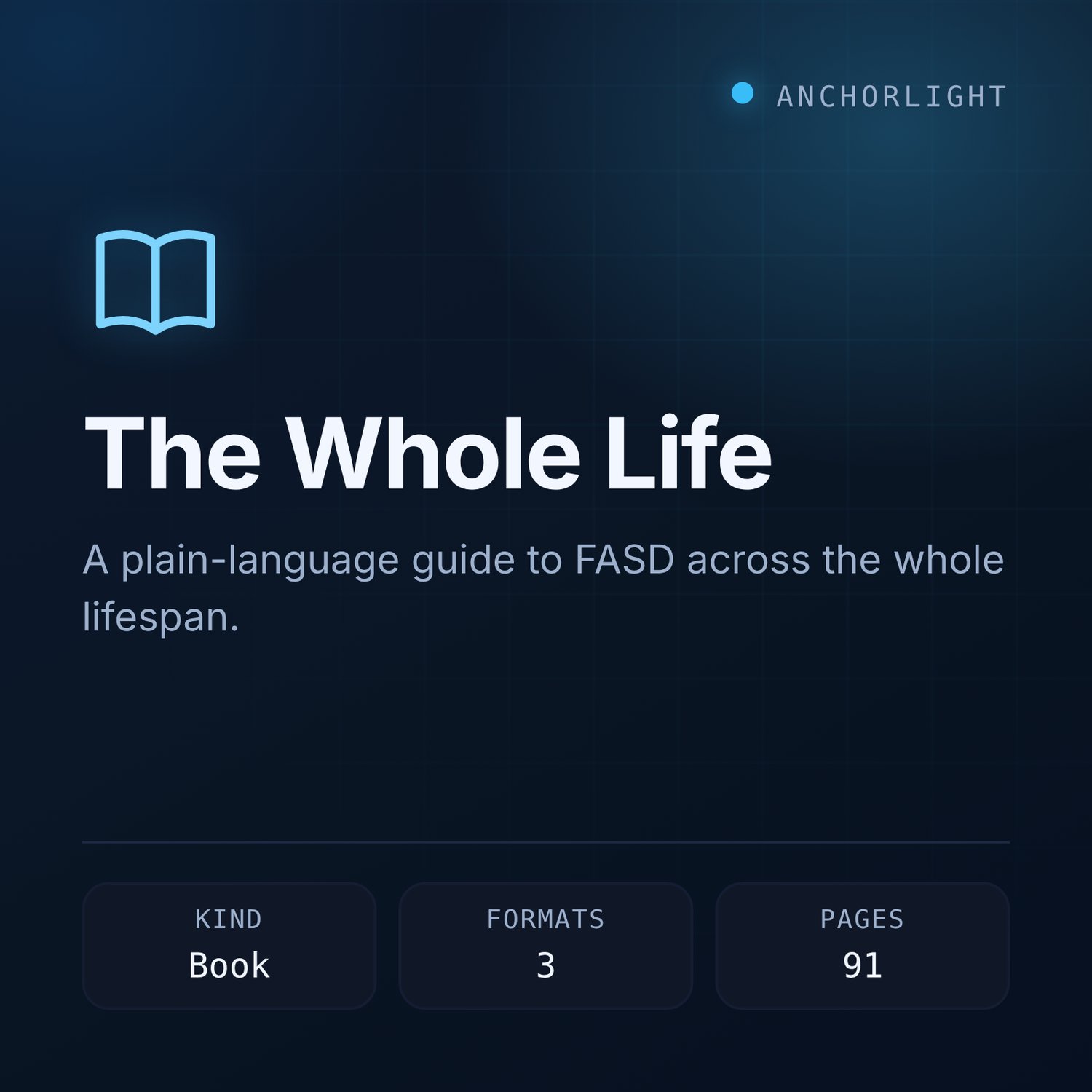
The Whole Life: A Plain-Language Guide to FASD
Researchers assessed 6,639 first-graders across four US communities. They found Fetal Alcohol Spectrum Disorder in 222 of them. Two had ever been diagnosed.
That is the problem this book exists to solve.
Conservatively, Fetal Alcohol Spectrum Disorder affects between 1.1 and 5 percent of people (May et al., JAMA, 2018) - in a school of 500 children, that's 5 to 25 of them. Most have no facial features, a normal IQ, and no diagnosis. They have been called lazy, defiant, manipulative, immature, and difficult. Many are in prison. Most have no idea why life has been so much harder for them than it seems to be for everyone else.
This is a book about what is actually happening, and what actually helps.
FASD is a brain-based condition. It is permanent. The person will not catch up.
But permanent is not the same as hopeless — and that distinction is the reason this book is not a list of terrible things that will happen.
Decades of research have found something remarkable: the outcomes in FASD are not determined by how much alcohol was involved, or by IQ, or by the shape of someone's face. They are determined by whether the person was diagnosed early, whether they had a stable home, whether they were protected from violence, and whether the people around them understood what they were looking at.
Every one of those is a human decision. That is the hopeful part, and it runs through all 91 pages.
WHAT'S INSIDE
24 chapters across four parts, plus a quick-reference card and a plain-language glossary.
Part One — What we're actually talking about
What FASD is, what alcohol does to a brain that is being built, and why a person can talk like an adult and understand like a young child.
Part Two — The whole life, stage by stage
Eight chapters running from before birth all the way through old age: infancy, preschool, early school, the widening gap at 10-13, adolescence, the cliff at 18, adulthood, and midlife and beyond. Most FASD resources stop at eighteen. This one doesn't — because people with FASD grow old, and almost nobody writes about that part.
Part Three — The threads that run through everything
Memory, time, and money. The body and the senses. The language trap. Why behavior is communication. Mental health, trauma, and the wrong diagnoses people collect instead. FASD and the justice system. And a chapter on strengths, because a list of only the difficulties is not a description of a person.
Part Four — What actually helps
Getting a diagnosis. The core approach. Building the external brain — a practical toolkit for home, money, school, work, health, and safety. What the research says actually changes outcomes. A chapter for the people doing the caring. And a final chapter written directly to the adult who has FASD.
WHO IT'S FOR
- Parents, adoptive parents, foster carers, kinship carers, and grandparents
- Adults who have FASD, or suspect they might
- Teachers, teaching assistants, and SENCOs
- Social workers, caseworkers, and family support workers
- Nurses, doctors, and therapists
- Probation officers, defense lawyers, and anyone working in the courts
- Anyone who has been told they are lazy, difficult, or not trying hard enough, and has never been told why
WHAT YOU GET
Three files. Same book. Pick whichever suits you.
1. Screen edition (PDF) — warm oatmeal pages instead of white, dark brown text instead of black. Lower contrast, less glare.
2. Print edition (PDF) — the same book with the page fills removed, so it prints cleanly without draining a cartridge.
3. Browser edition (HTML) — opens in any browser. Resize the text, use a screen reader, clickable contents.
Plus a short START HERE file that points you to the right one and tells you which chapters to read first depending on who you are.
A NOTE ON THE DESIGN
This book was set deliberately for people with sensory sensitivities — which includes a great many people with FASD, and a great many exhausted people caring for them.
No pure white anywhere. Warm low-contrast pages. No hard black text. No alternating stripes in the tables. Generous spacing. The heavy dark section dividers you'd normally find in a book like this were replaced with soft clay panels, because a full page of dark ink is a jolt every time you turn to one.
It is a small thing. It makes the book readable on a bad day.
ON THE RESEARCH
Every figure in this book is sourced, and the sources are listed at the back with links — the JAMA prevalence studies, the Lancet meta-analysis of co-occurring conditions, Streissguth's foundational work on protective factors, and the recent research on adult outcomes and employment. Where the book describes a pattern rather than a statistic, it says so.
It also lists the national FASD organizations in the US, Canada, the UK, and Australia, most of which offer free support.
PLAIN LANGUAGE, THROUGHOUT
No jargon without a translation. No blame — not of mothers, not of caregivers, not of the person themselves. Most chapters end with a section called "The Short Version," so if a chapter is too much on a hard day, you can read six lines and still have what you need.
This book provides general information and is not a substitute for individual medical, legal, or educational advice. If you are seeking a diagnosis or support, speak to a qualified professional in your area.
AnchorLight — Resources for Recovery, Healing & Peer Support